Why "Just Eat Less" Doesn't Work (And What Does)
Aug 06, 2026If "just eat less" actually worked long-term, none of us would still be talking about this. You've probably tried it. Most moms have. And most people end up right back where they started, sometimes hungrier and more frustrated than before.
Here's why it backfires
Restriction creates a scarcity response. When your brain thinks food is limited, it starts obsessing over food. Studies on restrictive eating patterns consistently show the same result: cutting too much too fast leads to intense preoccupation with food, followed by overeating once willpower runs out. That's not a personal willpower problem, that's biology doing exactly what it's designed to do when it senses scarcity.
There's also the all-or-nothing trap. One "off plan" meal starts to feel like the whole day is ruined, which leads to the classic spiral: eat something not on the list, feel like a failure, decide the day is a wash, keep eating past the point of actually being hungry, then start the restriction all over again tomorrow. Round and round.
What actually works is addition, not subtraction
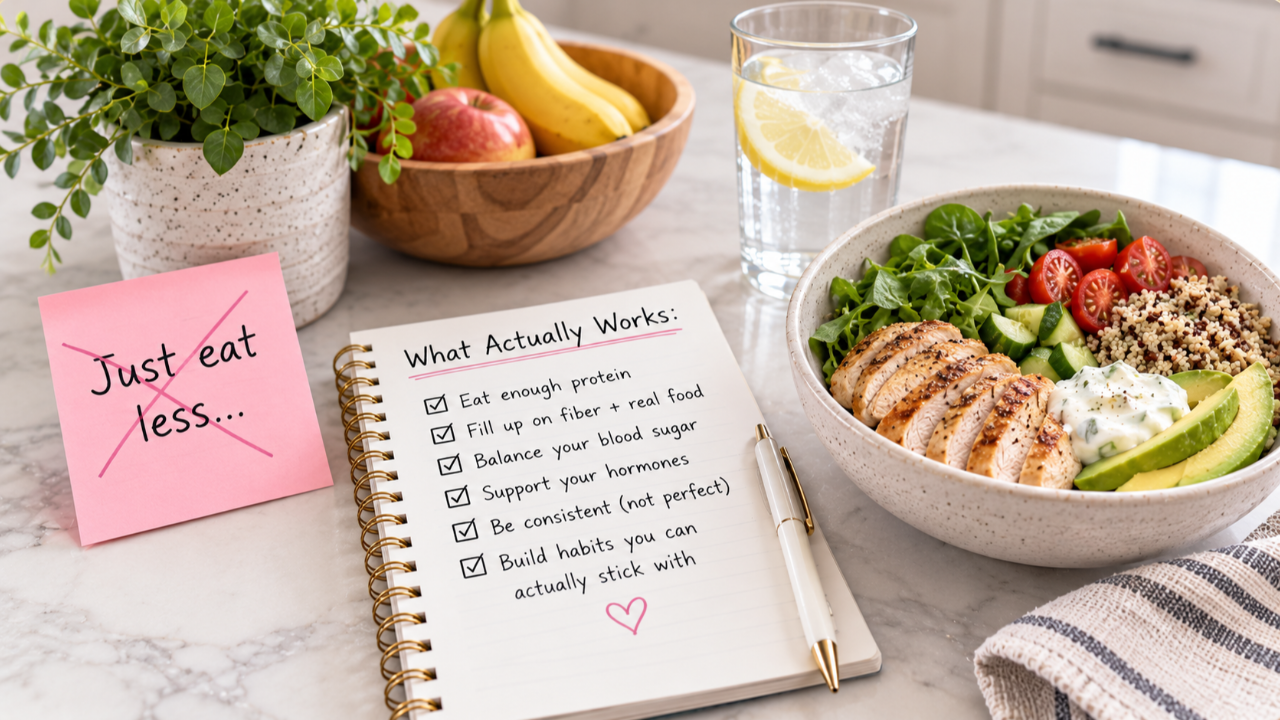
Instead of asking "what should I cut out," ask "what can I add in." Add protein. Add fiber. Add a vegetable to the plate you were already going to eat. Add a second snack if you're genuinely hungry.
When you focus on adding nourishing things, the less useful stuff naturally takes up less space on the plate. No white-knuckling required, no giant list of forbidden foods to memorize.
A few mindset shifts that help
- Food isn't a test you pass or fail. One cookie doesn't undo your whole day, and it definitely doesn't require "making up for it" later.
- Hunger is information, not a problem to override. If you're hungry, that's your body doing its job, not a character flaw.
- Consistency over time beats intensity for a week. Small, repeatable habits beat an aggressive plan you can't sustain past day four.
- Planning ahead removes a lot of the "all or nothing" pressure, because you're not white-knuckling decisions in the moment.
A simple way to try this out
Next time you're building a plate, don't start by thinking about what to remove. Start by asking: is there protein here? Is there fiber here? Add those first, then let everything else fill in naturally around them.
You don't need another rule. You need a plate that actually keeps you full and a mindset that doesn't treat food like the enemy.